

Many businesses invest heavily in marketing, sales and customer acquisition, yet lose significant amounts of money through poor inventory control.
For retail shops, pharmacies, hardware stores, supermarkets, wholesalers and distributors, inventory is usually one of the largest assets in the business. If inventory records are inaccurate, almost every financial decision becomes unreliable.
This is why inventory accounting deserves far more attention than simply counting stock at the end of the month.
Inventory represents money that has already been spent.
Every item sitting in a store, warehouse or back office has a cost attached to it. When inventory is not tracked properly, businesses may believe they are making healthy profits while hidden losses are quietly reducing their margins.
Common problems include:
Selling items below their actual cost, stock disappearing through theft or internal misuse, duplicate purchasing of items already available, expired, damaged or obsolete products remaining in the system, incorrect stock quantities affecting purchasing decisions.
Without accurate inventory accounting, these losses are often discovered too late.
Many business owners focus on increasing sales, but profitability is determined by the relationship between selling price, cost price and inventory movement.
Accurate inventory accounting helps businesses answer critical questions:
These insights are impossible to obtain reliably when inventory records are incomplete or outdated.
@bizkit.co Every product on your shelf is more than stock, it’s potential profit. But without proper stock management, that potential gets lost in dead stock, missed sales, and tied-up cash. #stockmanagement #stock #Inventory#inventorycheck #Reconciliation #biashara #smallbusinesskenya #kenyantiktok #fyp #fypシ゚ #kenyantiktok🇰🇪 #pos #possystem #kenyanbusiness
A declining gross profit margin is frequently an inventory problem before it becomes an accounting problem.
For example:
Regular inventory accounting allows businesses to identify these issues early and protect their profitability.
One common mistake is assuming that the products with the highest sales volume are automatically the best products for the business.
A product may sell very quickly but have extremely low margins, while another slower-moving item may contribute significantly more profit per sale.
Inventory accounting helps businesses compare:
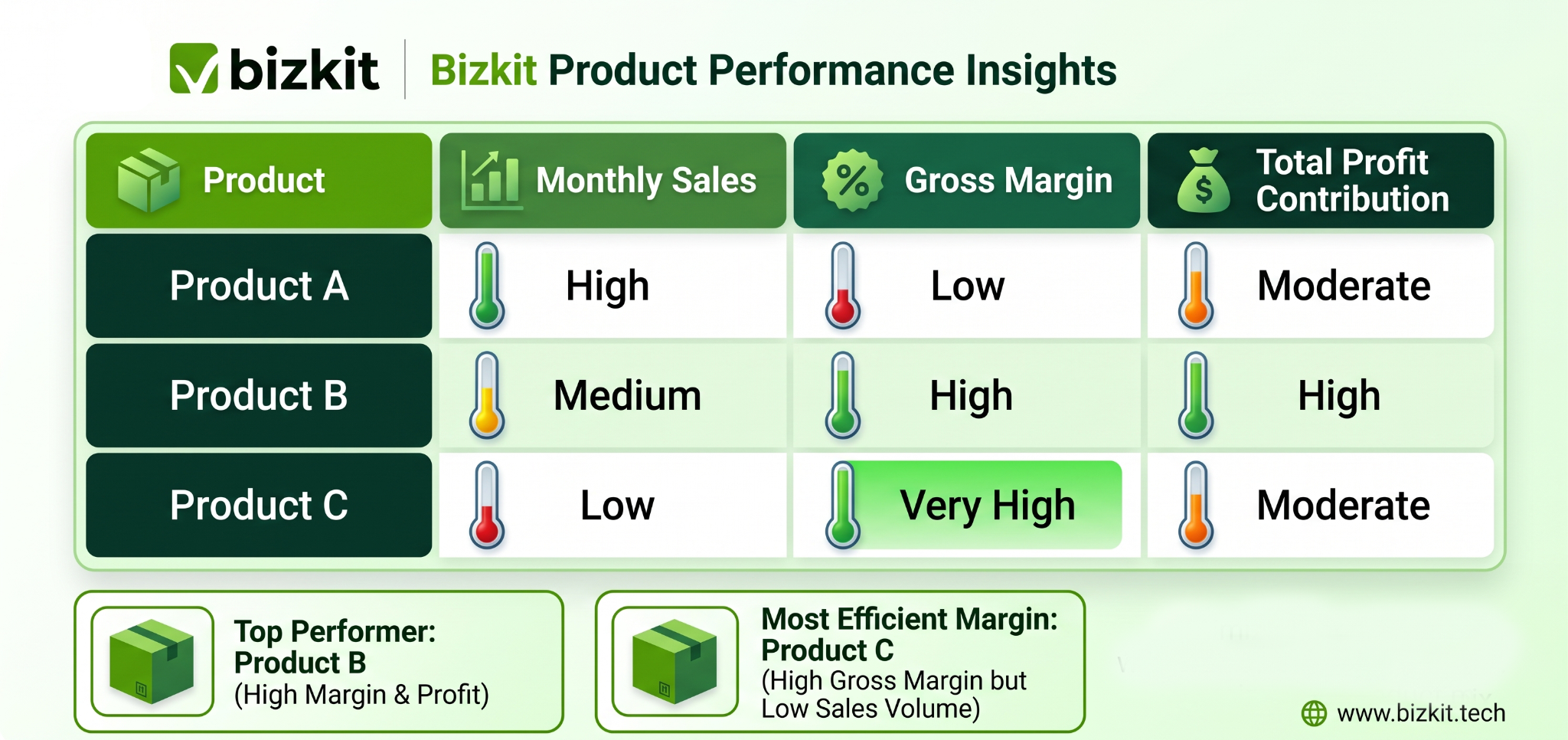
This analysis allows business owners to make smarter decisions about purchasing, promotions and shelf space allocation.
Inventory valuation determines how much inventory is reported as an asset and how much is recognized as cost of goods sold.
If stock is overvalued:
If stock is undervalued:
Consistent stock valuation methods are essential for producing reliable financial statements and meaningful management reports.
Many businesses perform a full physical stock count once a year. While this may satisfy basic accounting requirements, it is often insufficient for operational control.
A better approach is cycle counting – counting small sections of inventory regularly throughout the month.
For example:
Fast-moving items: weekly, Medium-moving items: monthly, Slow-moving items: quarterly
This approach helps businesses detect discrepancies quickly, investigate their causes and maintain more accurate inventory records throughout the year rather than correcting everything at year-end.

One of the biggest benefits of accurate inventory accounting is improved purchasing discipline.
Instead of relying on intuition, businesses can use historical data to determine:
This prevents both stockouts, which cause lost sales, and overstocking, which ties up capital unnecessarily.
Inventory accounting is often treated as an operational task handled by the storekeeper or warehouse team. In reality, it is a financial strategy that directly influences profitability, cash utilization, customer satisfaction and business growth.
Using a system such as BizKit makes this process significantly easier by combining sales, purchases and inventory tracking in a single platform. When stock movements are recorded automatically and inventory reports are always up to date, business owners gain a clearer understanding of product performance, profitability and operational efficiency, allowing them to make better decisions with far less manual effort.
Why Inventory Accounting is One of the Most Important Controls in Retail and Wholesale Businesses
Why Fraud and Theft Can Quietly Damage a Growing Business
Customer Retention: The Most Overlooked Business Tactic

Why is Daily Sales Reconciliation One of the Most Important Habits when Running a Business?